



What are the advantages of a pellet stove?
A pellet stove (also known as a pellet burner) is a heating solution that offers many advantages for homeowners. Here are the main ones:
- Cost-effective: Wood pellets are a renewable energy source that is significantly less expensive than oil, electricity or gas. They offer excellent value for money.
- Environmentally friendly: The combustion of pellets produces very few polluting residues and fine particles. Their origin (compressed wood waste) makes them a green energy source.
- Convenient: A pellet stove ignites and regulates itself automatically thanks to a room thermostat. You simply need to refill the pellet hopper regularly.
- High-performance: With efficiency levels exceeding 90%, pellet stoves provide a gentle and consistent heat throughout the home.
- Esthétique : Ces appareils au design soigné offrent l’ambiance chaleureuse d’un feu de bois traditionnel, sans les inconvénients de l’entretien et du ravitaillement.
A pellet stove therefore combines energy efficiency, optimal performance and low running costs. It is an excellent choice for homeowners looking to heat their homes in an environmentally friendly and cost-effective way.
How does a pellet stove work?
Pellet stoves (also known as pellet burners) are designed to provide fast and efficient heating using a renewable energy source: compressed wood pellets. Once loaded into the hopper, this fuel is fed into the combustion chamber by means of an auger system.
The heat produced is then distributed throughout the room by natural convection or with the help of a second fan. The combustion gases are, in turn, expelled outside via an exhaust flue.
- The hopper: its capacity determines how long the appliance can operate before needing to be refilled with pellets.
- The auger: it regulates the fuel supply according to demand.
- The ventilation system: it supplies the air required for optimal combustion.
- The flue system: it allows the fumes to be expelled outside.
This system, ensuring complete and controlled combustion of wood pellets, makes the pellet stove a particularly efficient, economical, and environmentally friendly appliance.
The different types of pellet stoves
The sealed pellet stove
The ductable pellet stove
The hydro pellet stove
The natural convection pellet stove
The fan-assisted convection pellet stove
Also known as a fan-assisted stove, this model distributes heat quickly and evenly over an area of up to 100 m² thanks to a fan. However, this can generate a slight noise disturbance. Quiet versions are available, allowing the ventilation to be reduced or switched off.
The main differences between pellet stoves and wood-burning stoves
Although pellet stoves and wood-burning stoves both provide an economical and environmentally friendly way of heating, they nevertheless present notable differences that should be taken into account.
The fuel
Pellet stoves burn compressed wood pellets, whereas wood-burning stoves operate using traditional logs. Pellets are easier to store and handle than a bulky stock of logs.
Efficiency
With energy efficiency rates exceeding 90% and low particulate emissions, pellet stoves are significantly more efficient than traditional log-burning stoves in terms of performance and compliance with environmental standards.
Ease of use
Ease of installation
Installing a pellet stove is simpler: it only needs to be connected to the flue system and supplied with electricity. Installing a wood-burning stove is more complex and restrictive.
Storage space
Pellets can be easily stored in a small dedicated space, far more compact than the large volume required for storing logs.
Thanks to these many practical advantages, pellet stoves are becoming increasingly popular as a modern, efficient, and comfortable everyday heating solution.
Choosing the right output according to your home
Maximum output
It may be tempting to choose a stove that is more powerful than necessary, but this is a mistake. An oversized appliance will never operate at full capacity, resulting in less efficient combustion, increased fouling, and higher consumption.
For a recent RT 2012-standard home with very good insulation, allow around 60 W per m², i.e. a 6 kW stove for 100 m². For an RT 2005 dwelling, allow around 100 W per m², i.e. a 10 kW stove for 100 m².
Minimum output
Once the desired temperature is reached, the stove switches to minimum output to maintain it. This minimum output should remain moderate, ideally around 2.5 kW. Above 3.5 kW, the appliance would operate too often at a low rate, in an inefficient manner.
To summarise the recommended outputs according to the type of dwelling:
- Low-energy or RT 2012 dwelling: 60 W/m² (e.g. 6 kW for 100 m²)
- RT 2005 dwelling or older renovated/insulated property: 100 W/m² (e.g. 10 kW for 100 m²)
- Older, uninsulated property: an energy assessment is recommended
For optimal sizing, it is best to seek advice from a SEGUIN professional, taking into account the specific characteristics of your home.
Price and cost of a pellet stove
- Included options and programmes: control systems, regulation features, etc.
- The design : a cast-iron stove with a large firebox will be more expensive.
Grants and financial incentives to fund your pellet stove
The government indeed offers various grants to encourage this efficient and environmentally friendly heating method:
- MaPrimeRénov’ support for low-income households
- The MaPrimeRénov’ Sérénité supplement for the most disadvantaged households
- The Home Renovation Advance Loan, available with no means-testing
- The energy voucher for low-income households
Thanks to these cumulative grants, purchasing a pellet stove can be made much more affordable, even for tighter budgets. Do not hesitate to book an appointment with one of our advisers at Cheminée SEGUIN.
What maintenance is required for a pellet stove?
Daily maintenance
- Empty the ash pan
- Vacuum the perforated burn pot to ensure proper airflow
Weekly maintenance
- Clean the glass and the door
- Dust the exterior panels and the ventilation grille
Monthly maintenance
- Visually check the flue gas collector
- Check the condition of the air intake pipe and the ignition plug
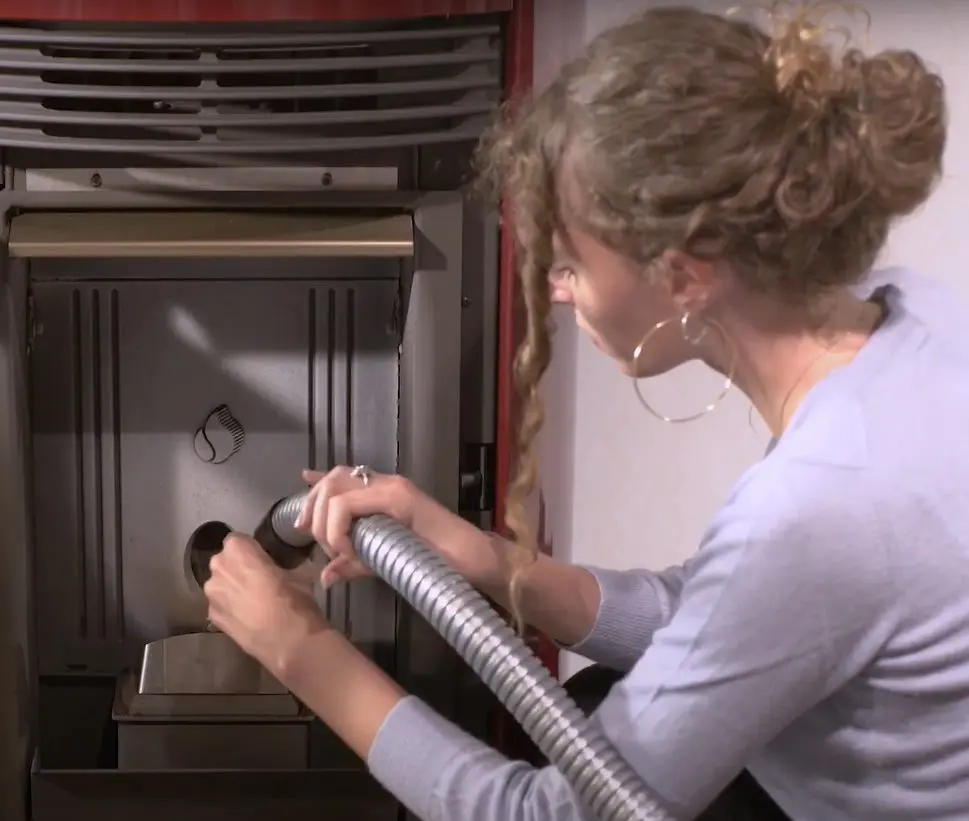
Annual servicing by a certified professional
For thorough maintenance, sweeping the flue ducts is essential, at least twice a year, including once during the heating season. The professional will also carry out:
- A complete cleaning of the heat exchanger
- Cleaning of the burn pot and the flue gas extractor
When choosing your stove, opt for a model that makes maintenance easier: a wide door, a removable burn pot, and a detachable ash pan. The quality of the brand’s after-sales service should also be taken into account.
A well-maintained pellet stove ensures longevity, safety and optimal performance. Regular maintenance is far less demanding than for a traditional log-burning stove.
Lifespan of a pellet stove
As pellet stoves have only more recently entered the market compared to traditional log-burning stoves, there is not yet enough long-term data to determine their exact lifespan. However, it is generally estimated to be around 15 to 20 years on average.
When properly maintained, your pellet stove will allow you to enjoy all its benefits—performance, convenience and energy savings—for many years to come.
How is a pellet stove installed in my home?
Installing a pellet stove is a relatively straightforward process that takes place in a few key steps:
- Connect the stove to these ducts.
- Connect the stove to a power supply.
When carried out to a high standard by a qualified professional, the installation of a pellet stove is completed quickly and seamlessly in your home.
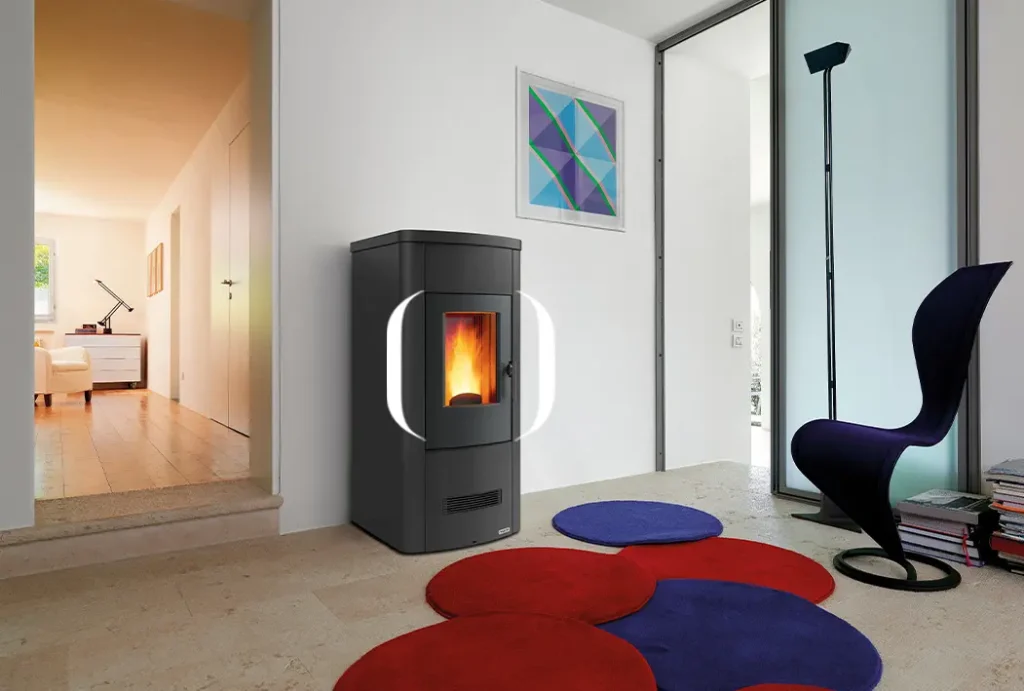
What location should you choose to install a pellet stove in a home?
1. Central room
2. Proximity to a flue outlet
Install the stove close to an existing outlet (chimney or ventilation flue) to ensure the safe removal of smoke and combustion gases.
3. Sheltered from draughts
Avoid areas exposed to draughts (doors, windows), as these can disrupt heat distribution and reduce the stove’s efficiency.
4. Safety clearance
Observe the minimum distances recommended by the manufacturer between the stove and walls, furniture or flammable materials to prevent any risk of fire.
By carefully following these recommendations, you will optimise the operation of your pellet stove for efficient, cost-effective and safe heating under the best possible conditions.
What should you keep in mind to choose the right pellet stove?
Choosing a pellet stove model should be based on several key criteria:
Output: it must precisely match the heating needs of the home-neither too low to be effective nor too high, in order to avoid operating at reduced capacity.
The type of heat distribution: room-sealed, ducted, hydraulic, etc., depending on whether you want to heat a single room, several rooms, or the entire home.
Price: expect to pay on average between €4,000 and €10,000 for a quality appliance, although many grants are available to help reduce this cost.
Ease of maintenance: opt for models that provide easy access to components requiring regular cleaning.
Location: in a central room, close to a flue outlet, sheltered from draughts, and with the recommended safety clearances observed.
By carefully considering these different aspects, you will choose a pellet stove that is efficient, comfortable to use, and economical over the long term.