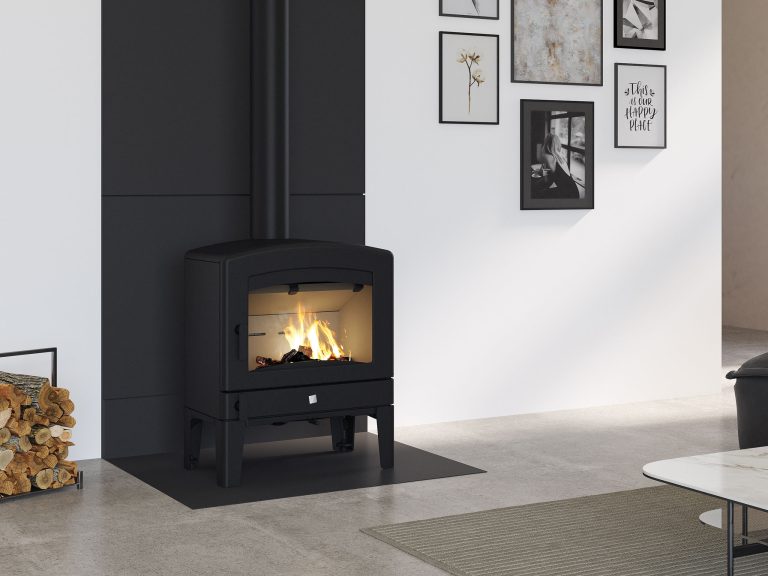
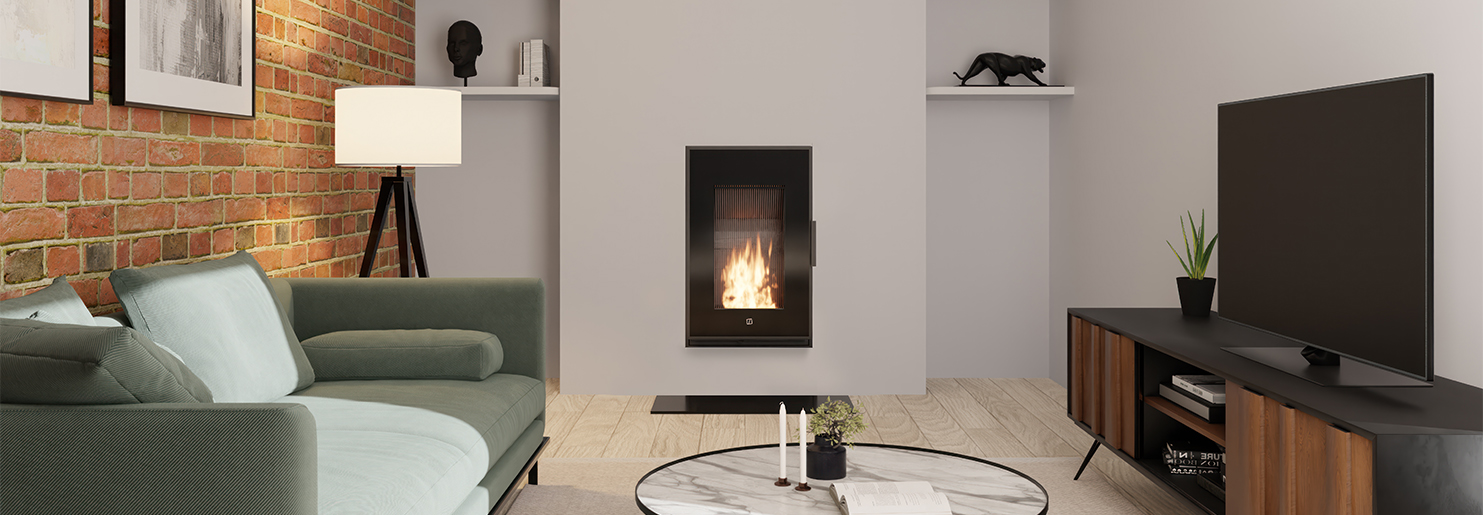
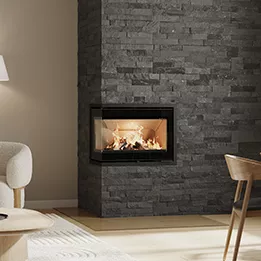
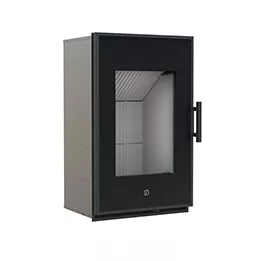
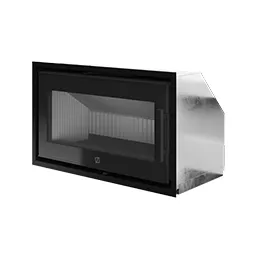
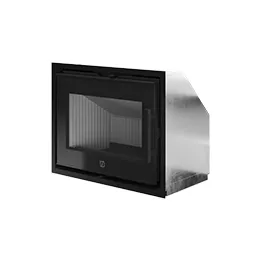
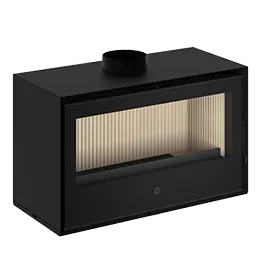
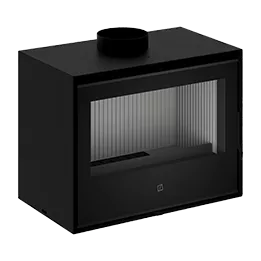
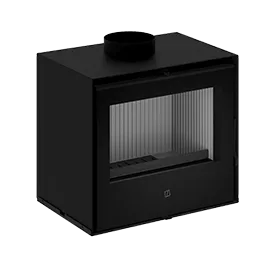
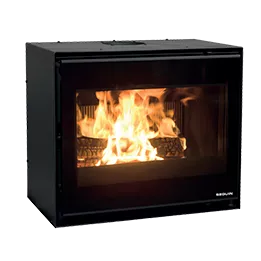
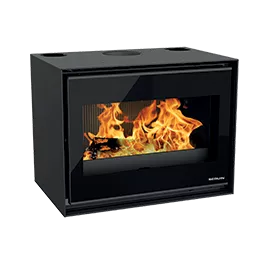
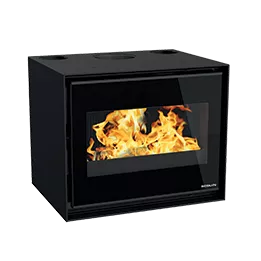
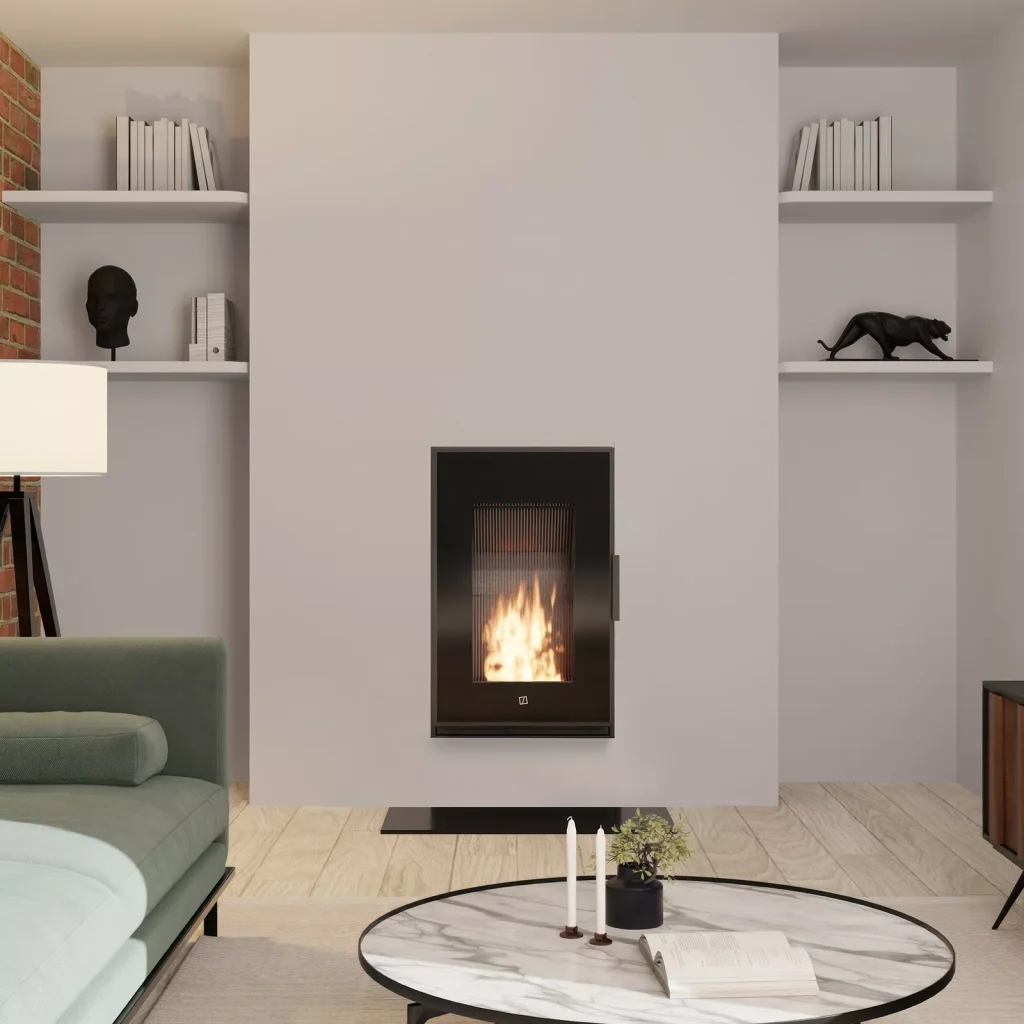
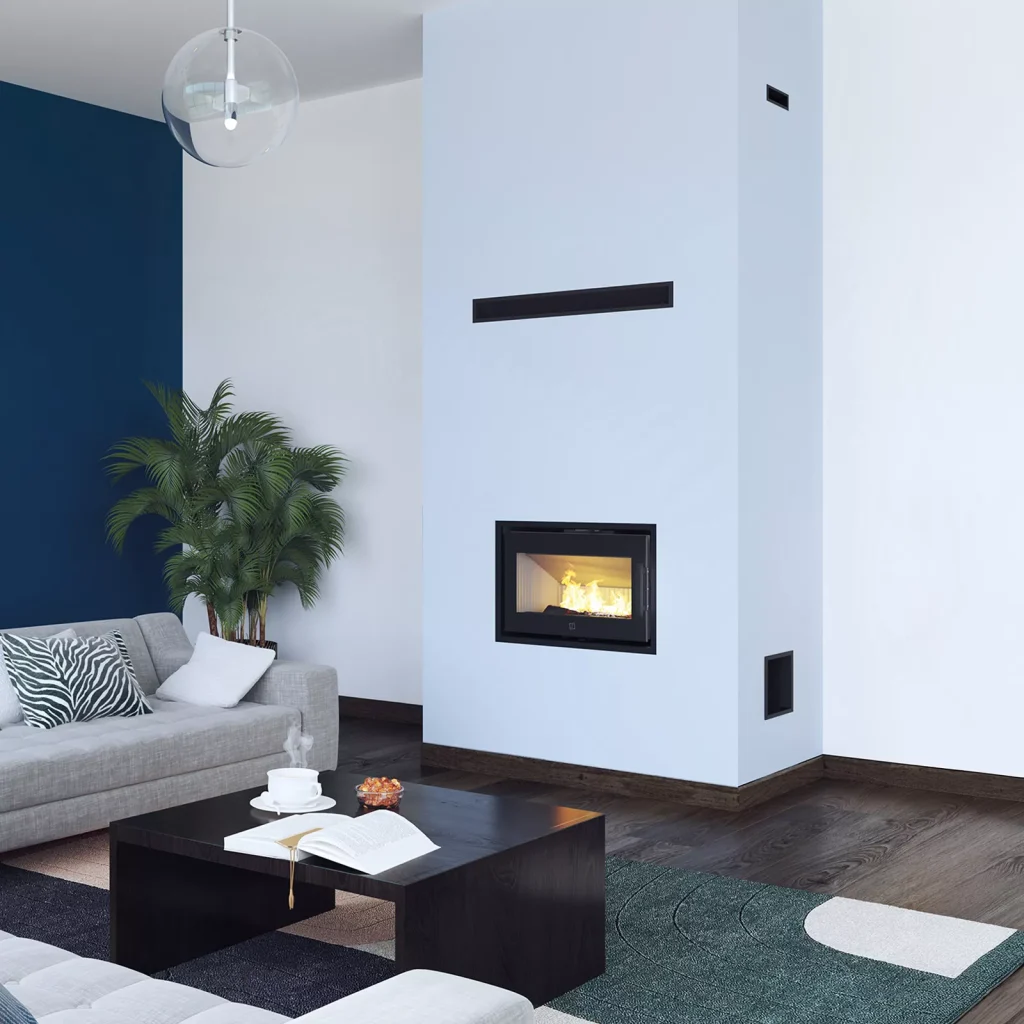
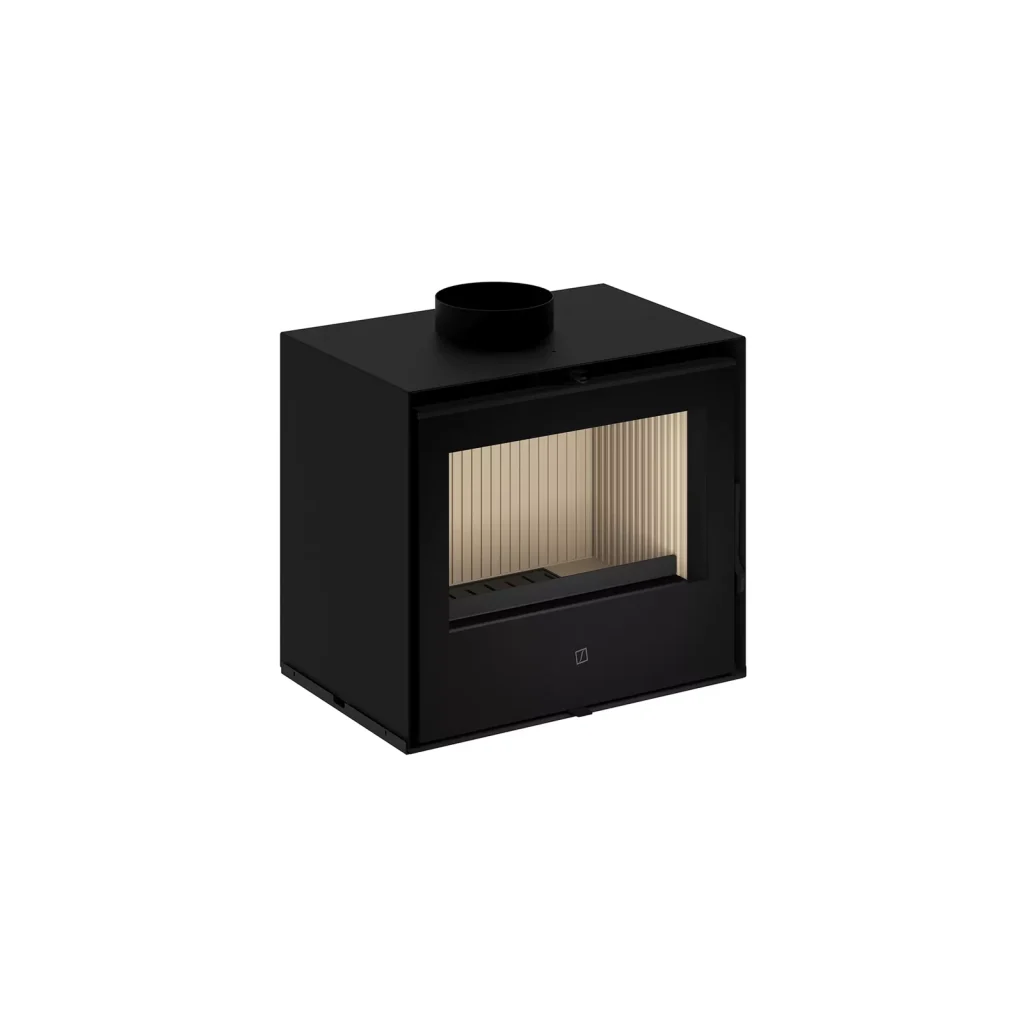
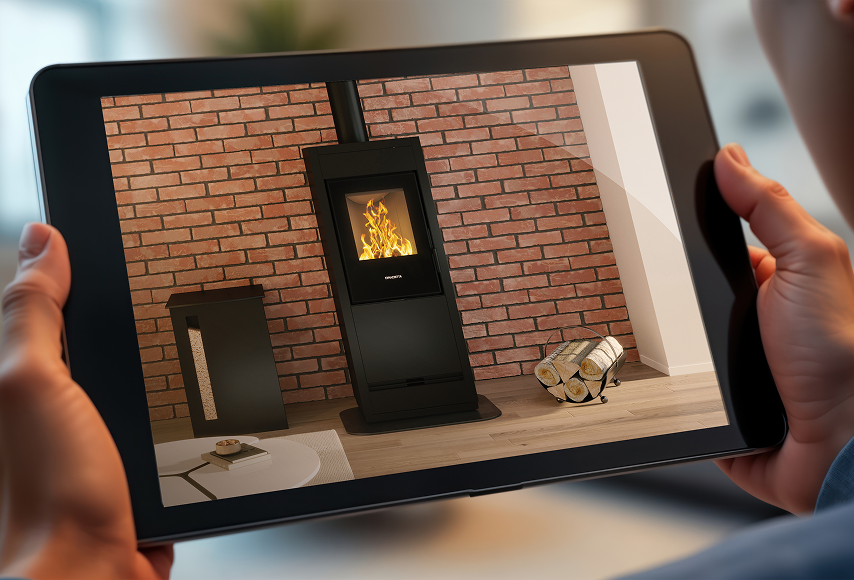
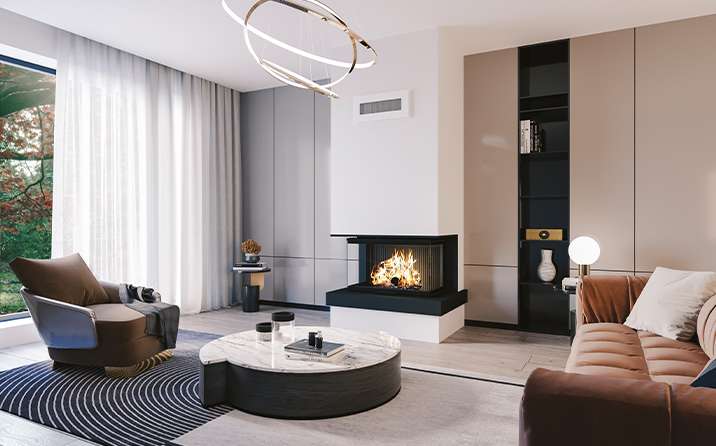
The I40/56 corner wood-burning insert stands out for its timeless design, which blends seamlessly into any architectural style—whether modern, contemporary, or more traditional.
Its corner configuration offers a wider view of the flames, creating a warm and inviting atmosphere while enhancing the living space.
Designed to combine aesthetics with ease of use, this insert features a discreet handle—almost invisible beneath the door—that blends seamlessly with the unit’s lines. Equipped with a flexible spring, it ensures a simple, smooth, and pleasant opening action, making it easy to use every day.
Combining elegance, practicality, and performance, the I40/56 insert is the ideal solution for transforming your fireplace into a true focal point of warmth and conviviality in your home.
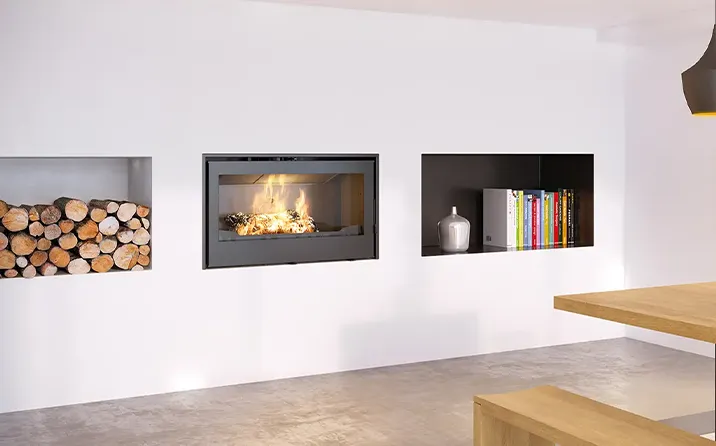
The OGAR single-sided steel insert captivates with its sleek design and high-end finishes, combining heating performance, durability, and aesthetic appeal. Designed to enhance the view of the fire, it features a large screen-printed glass panel that offers a panoramic view of the flames, creating a warm and bright atmosphere in your home.
Constructed of steel with a gray brick interior finish, it ensures rapid heating and even heat distribution. Its dual-combustion system improves efficiency while reducing emissions, delivering powerful and controlled heating.
Air-tight, the OGAR insert is perfectly suited for modern, well-insulated homes. Thanks to its connection to an external combustion air supply (Ø80), it ensures optimized combustion while maintaining indoor air balance. Its built-in convector promotes better heat distribution throughout the room.
Easy to use on a daily basis thanks to its swing door, it can be complemented by an adjustable extension kit up to 450 mm. Available in a single-sided configuration, the OGAR is also available as a stove to suit all interior design preferences.
The SELIO 80 single-sided steel insert combines heating performance, airtightness, and ease of use to meet the demands of modern homes. Its steel firebox, combined with a brick interior finish, allows for rapid heating while ensuring even and pleasant heat distribution. Its screen-printed glass enhances the view of the flames and adds a contemporary touch to your interior.
Thanks to its dual-combustion system, the SELIO 80 optimizes efficiency while reducing emissions. Its primary air adjustment and glass-cleaning system ensure controlled combustion and a cleaner glass pane day after day. Airtight, it is also equipped with a fresh air inlet for connection to an external air supply, ideal for high-performance homes.
Designed for simple and reliable use, it features a sturdy swing door. Available in a single-sided configuration, it can be supplemented with an extension kit or a ventilation kit. Available in three widths (60, 70, and 80), it easily adapts to all projects, whether new construction or renovation.
The SELIO 60 single-sided steel insert combines heating performance, airtightness, and ease of use to meet the demands of modern installations. Its steel firebox, paired with a brick interior finish, ensures rapid heating while distributing even, pleasant warmth. Its screen-printed glass enhances the view of the flames and adds a contemporary touch to your interior.
Equipped with a dual-combustion system, the SELIO 60 optimizes efficiency while minimizing emissions. Its primary air adjustment and glass-cleaning system ensure controlled combustion and a cleaner glass pane day after day. Airtight, it also features a fresh air inlet for connection to an external air supply, ideal for high-performance homes.
Designed for simple and reliable use, it features a sturdy swing door. Available in a single-sided configuration, it can be complemented by options such as a height extension kit or a ventilation kit. Offered in three widths (60, 70, and 80), it easily adapts to all projects, whether new construction or renovation.
The 1000 single-sided steel insert combines contemporary design, heating performance, and ease of use to meet the demands of even the most ambitious fireplace projects. Its steel firebox, combined with an interior finish of grooved gray bricks, ensures rapid heating while providing even and pleasant heat distribution. Its screen-printed glass enhances the view of the flames and adds an elegant, modern touch to your interior.
Designed for simple and reliable everyday use, it features a sturdy swing door. The primary and/or secondary air connection optimizes combustion, although some of the combustion air continues to be drawn from the room.
Available in a single-sided configuration, the 1000 insert can be customized with an interior finish of grooved beige bricks. Offered in five sizes, and also available in a double-sided version, it easily adapts to all projects, whether new construction or renovation.
The 800 single-sided steel insert combines contemporary design, heating performance, and ease of use to blend seamlessly into any fireplace project. Its steel firebox, paired with an interior finish of grooved gray bricks, ensures rapid heating while radiating even, pleasant warmth. Its screen-printed glass enhances the view of the flames and adds a modern touch to your interior.
Designed for simple and reliable everyday use, it features a sturdy hinged door. The primary and/or secondary air connection optimizes combustion, even if some of the combustion air is drawn from the room.
Available in a single-sided configuration, the 800 insert can be customized with an interior finish of grooved beige bricks. Offered in five sizes, it easily adapts to all projects, whether new construction or renovation.
The 700 single-sided steel insert combines contemporary design, heating performance, and ease of use to blend seamlessly into any fireplace project. Its steel firebox, combined with an interior finish of grooved gray bricks, allows for rapid heating while ensuring even heat distribution. Its screen-printed glass enhances the view of the flames and adds a modern aesthetic touch to your interior.
Designed for practical everyday use, it features a sturdy and reliable hinged door. The primary and/or secondary air connection optimizes combustion, even though some of the combustion air continues to be drawn from the room.
Available in a single-sided configuration, the 700 insert can be customized with an interior finish of grooved beige bricks. Offered in five sizes, it easily adapts to all types of projects, whether new construction or renovation.
The VISIO 7 PLUS single-sided cast-iron insert combines heating performance, safety, and quality design to seamlessly integrate into all your fireplace projects. Featuring a cast-iron firebox with a refractory ceramic interior finish, it ensures excellent resistance to high temperatures while promoting optimal heat distribution. Its screen-printed glass highlights the view of the flames for a warm and elegant ambiance.
Equipped with a dual-combustion system, the VISIO 7 PLUS improves efficiency while reducing emissions. Its secure swing door cannot be opened when the damper is closed, ensuring reliable daily use. The variable-closure nozzle damper allows for better control of draft and combustion.
Available in a single-sided configuration, this insert can be complemented by several options such as a convector, an adjustable hearth riser kit, or an adapter for an outside air connection. It thus easily adapts to installation constraints and performance requirements.
The 7026 single-sided cast iron insert combines durability, heating performance, and ease of use to blend seamlessly into any fireplace project. Entirely crafted from cast iron, with an interior finish also made of cast iron, it guarantees excellent resistance to high temperatures while ensuring even and long-lasting heat distribution. Its screen-printed glass enhances the view of the flames and adds an elegant touch to your interior.
Equipped with manually adjustable thermostatic fans, the 7026 insert optimizes heat distribution throughout the room for optimal thermal comfort. Its swing door ensures simple, reliable, and practical daily use.
Available in a single-sided configuration, this insert adapts to your installation with a door opening on the left or right. Offered in three sizes, it easily accommodates various layout constraints, whether in new construction or renovation projects.
The 7023 single-sided cast iron insert combines durability, heating performance, and ease of use to fit seamlessly into any fireplace project. Entirely crafted from cast iron, with an interior finish also made of cast iron, it offers excellent resistance to high temperatures while ensuring even and long-lasting heat distribution. Its screen-printed glass enhances the view of the flames and adds an elegant touch to your interior.
Equipped with manually adjustable thermostatic fans, the 7023 insert optimizes heat distribution throughout the room for controlled thermal comfort. Its swing door ensures simple, reliable, and practical daily use.
Available in a single-sided configuration, this insert can be adapted to your installation with a door opening on the left or right. The range comes in three sizes to suit various design and renovation projects.
The 6021 single-sided cast iron insert combines durability, heating performance, and ease of use to fit seamlessly into your fireplace projects. Entirely crafted from cast iron, with an interior finish also made of cast iron, it ensures excellent resistance to high temperatures as well as even and long-lasting heat distribution. Its screen-printed glass panel enhances the view of the flames and adds an elegant touch to your interior.
Equipped with manually adjustable thermostatic fans, the 6021 insert optimizes heat distribution throughout the room for controlled thermal comfort. Its swing door ensures simple and reliable daily use.
Available in a single-sided configuration, this insert can be adapted to your installation with a door opening on the left or right. The range comes in three sizes to suit various design and renovation projects.
A wood-burning insert is a heating appliance that, as its name suggests, runs on wood. It is specially designed to be installed inside an existing fireplace, transforming a conventional chimney into a more efficient, environmentally-friendly source of heat. By being built into an existing fireplace, the wood-burning fireplace insert gives you the opportunity to transform your old fireplace into a closed hearth with exceptional performance.
There are several significant advantages to using a wood-burning insert. Firstly, it improves the safety of your installation by preventing the risk of splashes. What’s more, it considerably increases the efficiency of your existing fireplace. Indeed, the wood-burning insert is able to recover most of the heat generated by wood combustion, which means more efficient use of the quantity of wood burned to heat your home. What’s more, the wood-burning insert optimizes the wood-burning process, reducing gas emissions from the combustion process. In short, the wood-burning insert is a sensible solution for enjoying the warmth and ambience of a wood fire, while maximizing its efficiency and minimizing its environmental impact.
How does a wood-burning insert work?
The wood-burning insert is made of cast iron or steel. It is designed to be integrated into an existing fireplace, considerably improving the efficiency of these older installations. From an operational point of view, ambient air enters the appliance through its lower section. The air then heats up as it travels around the unit. As the air heats up, it rises to the top of the wood-burning insert and is finally exhausted through the grilles provided. This approach promotes natural distribution of the heat generated by convection in the room where the insert is installed. At the same time, the insert’s glass also emits heat by thermal radiation. What’s more, wood-burning inserts are meticulously designed to optimize combustion efficiency, guaranteeing a more complete and efficient combustion of wood than traditional open fireplaces, so you can save on heating costs.
How do I light a wood-burning insert?
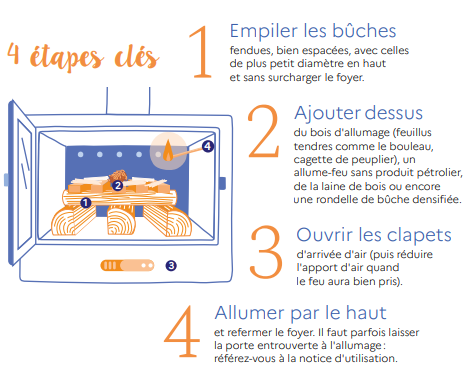
First of all, check that your wood-burning insert is clean and that there are no ashes left at the bottom of the unit. To start with, open the insert’s air inlets fully to facilitate initial ignition. Opening the air inlets fully will ensure an adequate supply of the oxygen needed to start combustion.
Once the air inlets are open, you can now lay out the wood. To do this, you can opt for a reverse ignition technique, which promotes slower, more controlled combustion. This method is ideal for producing heat that is durable, efficient and less polluting.
Place the largest logs at the bottom of the insert to create a solid base.
Step 2: type of wood for lighting
Next, place ignition materials such as dry kindling, twigs or firelighters on top of the logs.
Step 3: Shaping and structuring the wood for your insert
Next, place larger pieces of wood on top of the kindling, forming a pyramid or teepee structure.
Step 4: Light your wood
Once the structure is built, light the kindling.
Once the fire is lit and well established, adjust the insert’s air inlets in accordance with the manufacturer’s instructions to optimize and control combustion. If combustion is not supplied with sufficient air, it may be more polluting and less efficient. On the other hand, if too much air is introduced during combustion, the wood will burn out very quickly.
Here’s a video showing you how to light your fire:
The different types of wood inserts for your fireplace
Today, there are several types of wood-burning inserts, but when it comes to the materials used to manufacture inserts, there are currently two main categories of inserts: steel inserts and cast-iron inserts.
Steel inserts :
Many manufacturers offer steel inserts because of their cost. Indeed, being generally less expensive than cast iron, steel inserts are more attractive from a financial point of view. In addition, they have the advantage of heating faster than cast iron. However, they have less thermal inertia than cast iron.
Cast-iron inserts for fireplaces:
Cast-iron inserts feature excellent thermal inertia, with a high capacity to store and gradually diffuse heat. This enables them to continue warming the room for some time even after the fire has gone out. What’s more, cast-iron inserts are renowned for their long-term durability.
From a technological point of view, there are also differences depending on the model.
Natural convection:
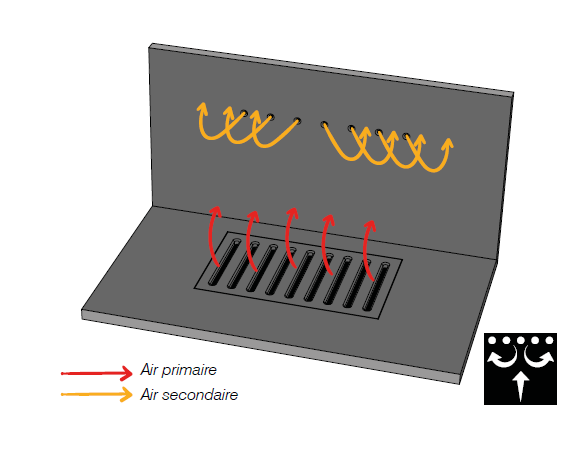
These inserts primarily use natural convection to distribute heat around the room. Air is drawn into the insert through the lower part of the appliance, then heated by contact with the hearth and rising naturally before being distributed into the room via grilles. This heating concept has the advantage of not requiring complex electrical or mechanical components. It also distributes heat evenly throughout the room. However, some manufacturers, such as SEGUIN, have perfected this system by developing technologies such as double combustion or double flow to further improve the appliance’s performance, but also reduce the gases that escape from it.
Double combustion:
To enhance the performance of wood-burning inserts, SEGUIN has designed inserts with a double combustion system. This process consists of injecting oxygen at a certain height inside the firebox, causing the partially burnt gases to burn before being released into the atmosphere. This ‘second’ combustion almost completely eliminates unburned residues.
Double flow :
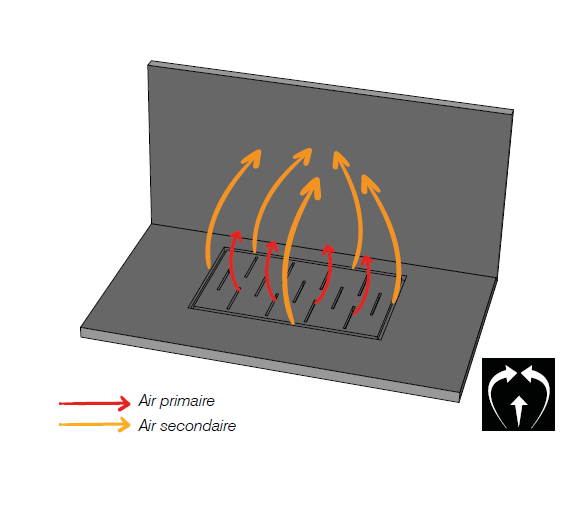
A second type of insert developed by manufacturers is the double-flow insert. Unlike double combustion, where oxygen is introduced at a certain height into the firebox, with double-flow all oxygen is introduced at the hearth plate (the plate at the bottom of the insert). This system creates two flows: primary air through the grate and secondary air that envelops the fuel, trapping and re-burning combustion gases. This new method of air injection considerably reduces combustion emissions and improves appliance performance.
forced convection inserts :
Forced convection inserts are distinguished by the use of an integrated ventilation system to accelerate the circulation of hot air in the room. This device, usually a fan, actively propels the heated air through the insert, distributing it more rapidly and evenly throughout the environment. However, it’s important to note that forced convection inserts require a power source to operate the fan. Consequently, in the event of a power cut, the heating capacity of the insert could be compromised.
What are the components of wood-burning inserts?
To better understand how a wood-burning insert works, it’s important to grasp its composition.
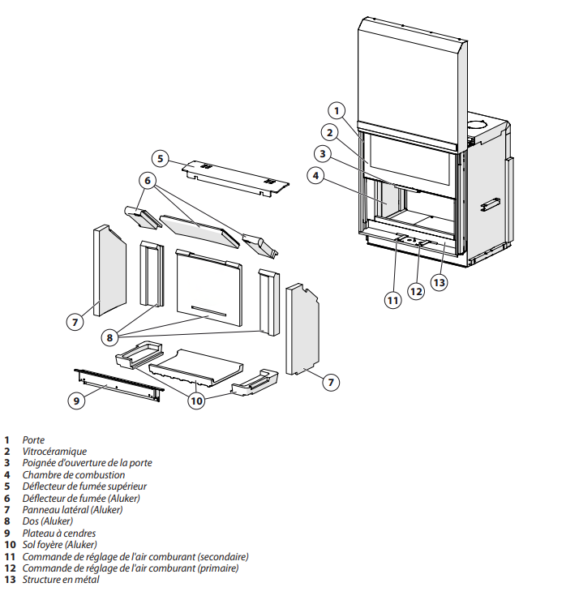
The initial component of a wood-burning insert is the glass door. In fact, inserts are equipped with a glass door that allows you to observe the combustion chamber, and thus appreciate the beauty of the burning log. This glass also serves to protect you from any sparks or ashes that may be projected. It also helps to transmit heat by radiation.
The second element you’ll find in a wood-burning insert is the combustion chamber. This is the heart of the insert, where the wood is burned to generate heat. Inside the combustion chamber is the ash pan, which collects the ashes.
Then there are the smoke deflectors. This part is of major importance in the operation of the wood-burning insert, as it guides the smoke towards the flue. In effect, the deflector creates a link between the combustion chamber and the flue. Without the baffles, the smoke from combustion would escape too quickly, impairing the quality of combustion and therefore the efficiency of the appliance.
Finally, there are the controls for regulating the air supply, whether primary or secondary. These controls offer the possibility of adjusting the opening of the air inlets, allowing you to control the quality of combustion. At the start of combustion, we recommend opening them fully to let as much air as possible into the appliance. Thereafter, it is advisable to reduce the opening once combustion is well underway.
The advantages of wood-burning inserts for your fireplace
Choosing a wood-burning insert for heating can have many advantages.
First of all, a wood-burning insert doesn’t involve any major installation costs. In fact, given that you already have a fireplace, installation is greatly simplified, which is not necessarily the case for installing a boiler.
The second advantage is the performance offered by the wood-burning insert. A wood-burning insert is designed to maximize the efficiency of wood combustion, which means it produces more heat using less wood than your old fireplace. By way of comparison, on average, an open fireplace has an efficiency of 15%, compared with between 65 and 85% with a wood-burning insert(Ademe – Comment bien se chauffer au bois). A significant heating saving today.
A third advantage of the wood-burning insert is its reliability. As explained above, wood-burning inserts are simple heating appliances, with no electronics, which means fewer problems. In fact, the simplicity of the appliance’s operation guarantees high reliability.
Another advantage of a wood-burning insert is the cleanliness of your room. Indeed, as the insert is closed, it will no longer dirty your room with the dust or ashes it produces.
What’s more, a wood-burning insert also has the advantage of reducing pollutant emissions, thanks to optimized combustion and systems such as double combustion or double flow.
Finally, the wood-burning insert is a heating appliance that is independent of electricity. So, in the event of a power cut, you’ll still be able to heat your home!
What maintenance is required for a wood-burning insert?
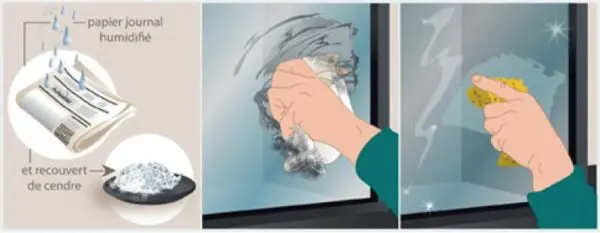
To ensure the long-term performance and preservation of your wood-burning appliance, it’s essential to maintain it properly. The first essential step is to regularly empty your wood-burning insert’s ashtray. It’s essential to ensure that air can circulate normally within the combustion chamber to optimize combustion and, consequently, the performance of your appliance. The second necessary maintenance action to be carried out on a recurring basis is cleaning the glass of your wood-burning insert. To do this, you can use a damp cloth and well-cooled ashes:
First, let your insert cool down.
Next, dampen your cloth slightly with water.
Immerse the damp cloth in the sieved ashes.
Rub the glass, starting from the center and using circular movements.
Rinse with a damp sponge.
The third action to take is to clean the inside of your appliance and the hot-air grilles. To do this, you can use a brush and an ash vacuum cleaner to clean the bottom of your appliance.
Finally, in addition to these quick maintenance measures, it is mandatory for all wood-burning appliances to have a maintenance certificate issued by a professional, certifying the conformity of your appliance. You must also have your chimney swept once or twice a year, in accordance with local health regulations. A certificate will be issued to you, and may be required by your insurer in the event of a claim.
Here’s a video on good and bad practice:
How powerful should your wood-burning insert be?
When the question of wattage is raised, several factors need to be taken into consideration before defining it.
Indeed, depending on the location of your home, the volume you wish to heat, and above all the quality of your insulation, the power required for your insert will not be the same. It’s crucial to bear in mind that an oversized wood-burning insert, operating below its optimum speed, risks impairing combustion, leading to increased emissions of polluting gases and premature wear and tear on the heating system.
Furthermore, the quality of the insulation has a major influence on the power required. That’s why we recommend that you first consider improving your insulation before buying a wood-burning insert. As you can see, the right wattage for your wood-burning insert depends largely on the volume to be heated, as well as the quality of the insulation. As a guide, ADEME suggests the following power recommendations:
5 kW for a new home
Between 5 and 9 kW for a well-insulated home
Between 9 and 12 kW for very poorly insulated homes. As a general reference, we can also use :
1 kW for every 10 m² or 1 kW for every 25 m³. So, as explained above, it’s difficult to determine the exact power required for your insert without knowing the specifics of your home and the quality of its insulation. It is therefore advisable to seek professional advice to ensure that the wattage chosen for your appliance is appropriate, enabling you to save on heating costs by opting for a correctly sized appliance.
How much does it cost to install and obtain a wood-burning insert?
The price of a wood-burning insert varies widely, depending on your home and the installation. In fact, when buying a wood-burning insert, you need to take into account not only the price of the appliance itself, but also the cost of installation. A wood-burning insert costs between 3,000 and 5,000 euros. As far as installation is concerned, if your chimney is in good condition and the flue is functional, the insert can be installed very quickly. All you have to do is insert the insert into the chimney and connect it to the flue. Installing an insert under these conditions can cost around 500 euros. Of course, this price is only a guide, and may depend on other factors that may increase or reduce the cost. On the other hand, if your installation requires the creation of a chimney, flue and casing, and this work has to be carried out over several days, installation can be as expensive as the insert itself. You can expect to pay around 1,500 euros for a complex installation. Of course, this figure is only a guide and may vary depending on your home and the extent of the work involved. Finally, to help you buy a wood-burning insert, there are government grants ranging from 800 to 2,500 euros, thanks to the ANAH (Agence Nationale pour l’Amélioration de l’Habitat), which offers Ma Prime Rénov’, a subsidy associated with all energy renovation work involving an RGE (Reconnu Garant de l’Environnement) professional.
Estimate the power of your future SEGUIN appliance
Do you have a heating or renovation project in mind?Wood or pellet stoves, fireplaces or stoves: start with a simulation, a quick first step towards sustainable thermal comfort.
Supporting you also means advising you. In our blog, you’ll find practical answers to all your questions about thermal comfort. What financial assistance is available for the purchase of a wood-burning stove? How do you safely extinguish a fireplace? Take advantage of our expert advice.
How can you modernise your fireplace with an insert?
Traditional fireplaces have undeniable charm, but their open hearths may no longer meet modern requirements and regulations. Installing an insert gives your fireplace a second life while improving its energy efficiency and reducing its environmental impact. Are you lucky enough to have a fireplace at home, but can no longer use it due to local […]
The Technique for Lighting a Wood Fire in an Insert
Placing the Logs Step 1 Place the logs in your or fireplace while respecting the load limits described in the user manual of your appliance. The logs must be split and dry (less than 20% moisture content). Step 2 : Add 2 or 3 layers of kindling on top of the logs, alternating the direction. […]
Definition, advantages, choosing the right model: everything you need to know about wood-burning inserts
By installing a wood-burning insert in your fireplace, you are choosing performance, style and sustainability. Details, key benefits and advice: the experts at the Seguin Group explain everything you need to know about this appliance, which is appealing to more and more households across France. You’ve heard about them, you’ve seen them, and thought they […]
Pellet stove maintenance: complete guide and advice
Installing a pellet stove is an excellent choice for environmentally friendly and cost-effective heating. However, like any heating appliance, regular maintenance is essential to optimise its performance and longevity. This guide will help you master the maintenance of your pellet stove, allowing you to make the most of its benefits. Daily and weekly maintenance of […]