



Are you building or renovating your home and wondering about your heating system? Would you like to replace your traditional heating system to save money? Have you considered installing wood heating as your main source? Advantages, disadvantages and practical advice – we explain everything!
The advantages of wood heating as a main source
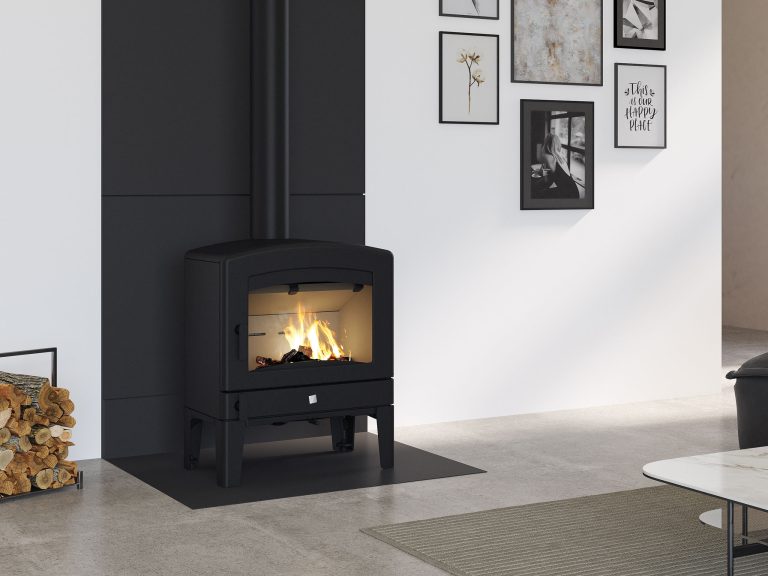
Do you dream of a living room that is neither too hot nor too cold, where the light dances with the flames? Why not choose a wood-burning or pellet stove to heat your room – or even your entire home? In addition to providing natural warmth, a wood stove creates a soft and unique atmosphere in your interior.
This sense of comfort is largely explained by the stove’s heating method. The heat produced by the fire in the stove’s firebox spreads through the casing, which is often made of cast iron or steel. The heat is then gradually released into the room through radiation, convection and heat storage. This is what creates a pleasant, even and enveloping warmth.
Heating with wood also means choosing a solution that has less impact on the environment. Wood is a renewable energy source and carbon neutral. Moreover, modern heating appliances are far more efficient than a traditional fireplace. Consider this: Seguin wood stoves have an efficiency rating of between 70% and 85%, whereas a traditional fireplace has an average efficiency of just 10% to 30%.
An essential factor for the environment, but also for your budget. Although the price of wood and pellets has risen significantly in recent years, they remain among the most cost-effective energy sources for use as a main heating system. It is therefore an ideal solution for reducing your heating bills.
Almost convinced? You should also know that wood-burning or pellet stoves are easy to install, whether in a new home or an existing one. The appliance simply needs to be connected to a flue to evacuate combustion gases.
If you are building or renovating your home, you can install wood heating as your main heating system if the area to be heated is less than 100 m². Your appliance must then be equipped with a manual shut-off device and automatic adjustment based on the indoor temperature.
It is also possible to install a warm air distribution system, which allows you to heat the entire house. And keep in mind that a main heating system is not the same as a sole heating system. It is perfectly possible to complement your wood-based main heating with a reversible air conditioning system, providing additional warmth in winter and a cooling effect in summer.
Another option for heating with wood is a pellet boiler. It can be used to heat radiators and provide hot water. Thermolab pellet boilers, a brand of the Seguin Group, are both economical and environmentally friendly. However, bear in mind that installing a boiler requires a boiler room and a dedicated space for storing pellets in a silo, located close to the boiler.
Organisation and planning: the secrets of wood heating
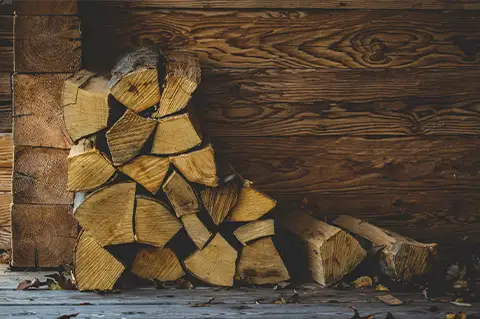
Heating with wood requires a bit of organisation. As winter approaches, it is recommended to build up a stock of wood or pellets so you can get through the cold season with peace of mind. Also make sure to use the right type of wood to improve both performance and maintenance.
Wood should be stored in a dry and well-ventilated place. Ideally, your logs should be kept under a shelter with open sides to allow airflow, and placed on a pallet so that air can circulate underneath the wood.
Pellets come in 15 kg bags and must be kept completely dry. Ideally, they should be stored in a garage or a utility room.
On a daily basis, you need to remember to refill the appliance regularly with wood or pellets. With a pellet stove, once the hopper is filled, the stove automatically feeds the fuel into the firebox. Convenient!
It is worth noting that today, most pellet stoves can be programmed to switch on at set times or to maintain a desired temperature. You can even start your appliance using a simple remote control or via a mobile app. For example, you can turn on your stove as you leave work, so your home is warm when you arrive.
Finally, remember to set aside some time for cleaning and maintaining your stove. You simply need to empty the ash pan regularly and carry out a full cleaning of your stove once or twice a year. For a pellet stove, it is recommended to clean the brazier daily and vacuum the ash weekly.
Wood stove, pellet stove, fireplaces: what’s the difference?
The main difference between a fireplace and a stove is that the latter is a standalone heating system. It can be installed anywhere in the home and operates independently. It simply needs to be connected to a flue.
There are two main types of stoves: the wood-burning stove, which operates by burning logs, and the pellet stove, which uses small compressed wood pellets, also known as “pellets”. These are made from waste from the wood industry. In France, the majority of pellets and wood consumed are produced domestically. This local and sustainable energy supports a sector that represents nearly 400,000 non-relocatable jobs.
And for those who cannot make a choice, there are also hybrid stoves that use both pellets and wood.
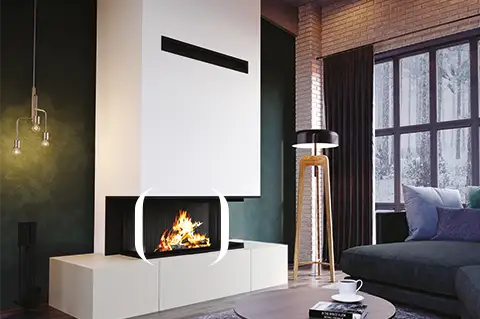
A fireplace, on the other hand, is an architectural feature that radiates heat within a room. A close relative of the fireplace is what you may have heard referred to as a “firebox”. A fireplace firebox is designed to maximise heat while ensuring clean and safe combustion. Finally, still within the realm of fireplaces, you can also opt for an insert. This is a wood-burning heating appliance that is built into an existing fireplace or integrated into a custom surround. Thanks to its large glass panel, an insert is more efficient and safer than a traditional fireplace.
Output, installation: our advice for optimising the use of wood heating

If you choose to install a wood stove as your main heating system, it is important to select the right appliance. First of all, consider its output, as this will determine the area the stove can heat. Most stoves have an output ranging from around 5 to 14 kilowatts (kW). This corresponds to the maximum amount of heat the stove can produce in one hour of combustion.
To ensure your stove is perfectly suited to your needs, you must take into account the surface area and volume to be heated, the insulation of your home and the climate. A stove that is not powerful enough will be inefficient, while an overly powerful stove will lead to excessive combustion and therefore wasted wood. In addition, as the stove will operate at a low rate, the flue will become clogged, making it less comfortable to use.
The dimensions of the stove should also be taken into account. For it to be fully effective, the appliance must have enough space around it. Also make sure there is sufficient room to easily load wood or pellets, and ensure that safety distances from combustible materials are respected. Most wood stoves measure between 80 and 120 cm in height, 40 to 80 cm in width, and 40 to 60 cm in depth.
Before making your choice, it is recommended to consult a professional from the Seguin “Une histoire de flamme” network. With nearly 170 retailers across France, all trained at the SEGUIN Training Centre (Qualiopi-certified), they ensure high-quality installation and maintenance, allowing you to enjoy your appliance for many years. The Qualiopi-certified training centre is dedicated to the latest innovations, technologies and installation techniques for appliances manufactured and offered by all the group’s subsidiaries.