
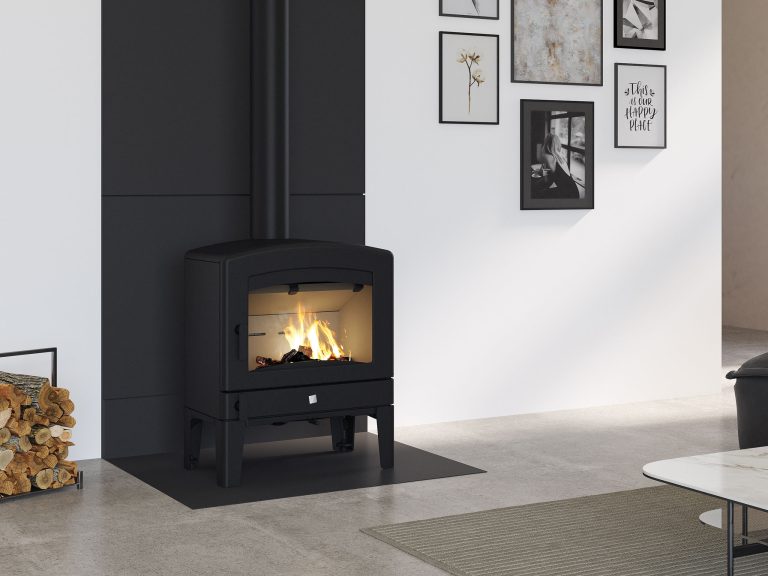



Choosing the ideal output for your wood-burning stove is a crucial step in ensuring efficient and economical heating for your home. A properly sized appliance will guarantee thermal comfort, energy savings and durability. In this comprehensive guide, we help you determine the exact capacity suited to your needs, based on your living space, the insulation of your property and your lifestyle.
Recommended output according to the size of your home
To help you get a clearer picture, here is a summary table of the output levels generally recommended according to the size of your home and its level of thermal insulation:

Please note that these values are indicative and should be adjusted according to the specific characteristics of your home and your heating needs. We recommend consulting a Seguin expert to determine the ideal output for your appliance.
How to calculate the ideal output of a wood-burning stove?
Determining the heating capacity required for your wood-burning stove is not an exact science, but several reliable methods can provide an accurate estimate. Before making any purchase, take the time to carry out this calculation to avoid sizing errors that could affect your comfort and your wood consumption. Our entire team is here to support you with your investment and installation project for your wood-burning stove.
The calculation method based on the area to be heated
The simplest and most widely used method is to estimate the required output based on the area to be heated. For a standard home with average insulation, the following ratio is generally applied:
- 1 kW of output for approximately 10 m² of living space
This rule provides an initial estimate of the required capacity. For example, to efficiently heat a home of 80 m², you would need a wood-burning stove of around 8 kW. However, this approach does not take into account certain important factors such as the quality of insulation, ceiling height and the geographical location. In addition, it is preferable to size your appliance according to the area you actually wish to heat. Indeed, measuring the temperature across the entire surface of a house may reveal variations depending on the room in which your stove is installed.
Factors influencing the choice of output
Several factors may lead you to adjust the initially calculated output:
- Quality of insulation: a very well-insulated home (RT2012 or RE2020 standard) will require less output, around 0.45 kW to 0.6 kW per 10 m², whereas a poorly insulated property will require more, around 1.2 to 1.5 kW per 10 m².
- Climate of your region: colder areas such as north-eastern France will require a higher output
- Ceiling height: high ceilings (above 2.5 m) increase the volume to be heated
- Layout of the home: a multi-storey property may require a different distribution of heat
- Presence of large glazed openings: a potential source of heat loss
The relationship between volume and output
For a more precise estimate, you can also calculate based on the volume to be heated:
- 1 kW for approximately 25 to 30 m³ of space
To calculate the volume, multiply the floor area by the ceiling height. For example, a room of 50 m² with a height of 2.5 m represents a volume of 125 m³, theoretically requiring a stove of 4 to 5 kW.
This approach is particularly useful for homes with unusual ceiling heights (mezzanines, converted lofts, etc.). Do not hesitate to consult our wood-burning stove specialists for a personalised assessment of your needs.
What output should you choose for a wood-burning stove in a small space (30 to 60 m²)?
Quelle puissance de poêle à bois pour une petite surface (30 à 60 m²) ?
Pour un studio, un appartement ou une petite maison entre 30 et 60 m², optez généralement pour un poêle à bois d’une puissance de 3 à 6 kW. Ces modèles compacts sont parfaitement adaptés aux espaces restreints et offrent un chauffage efficace sans risque de surchauffe.
Le poêle à bois design MINI 2 NOIR de Seguin, par exemple, offre une capacité idéale pour ce type d’espace tout en apportant une touche esthétique à votre intérieur.
Si votre domicile est particulièrement bien isolé (construction récente ou rénovation énergétique), vous pourriez même envisager un modèle de 3 kW, tandis qu’une protection thermique moyenne à faible nécessitera plutôt 5 à 6 kW.

What output for a medium-sized area (70 to 100 m²)?
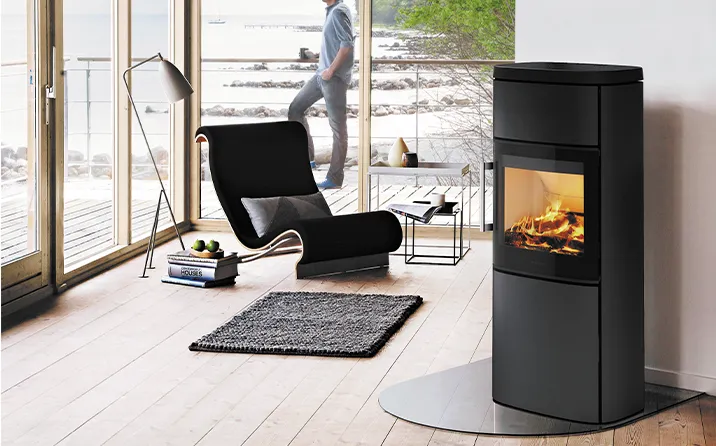
For a medium-sized home of between 70 and 100 m², the recommended output generally ranges between 7 and 10 kW. This range allows you to efficiently heat the entire living space, including several rooms if the layout allows it.
Models such as the P530T or the 4660N offer an excellent balance between output and design for this type of floor area.
If your home features an open-plan layout that promotes the circulation of warm air (open kitchen–living–dining area), you may be able to opt for a slightly lower output. Conversely, a more compartmentalised property with numerous partitions may require a more powerful stove or an additional warm air distribution system.
What output for a large area (over 100 m²)?
Quelle puissance pour une grande surface (plus de 100 m²) ?
Pour les grandes maisons dépassant 100 m², envisagez un poêle à bois d’au moins 10 à 12 kW, voire davantage selon la configuration et la protection thermique. Ces modèles plus puissants sont conçus pour chauffer efficacement de grands volumes.
Des modèles comme le SAPHIR ou le TOPAZE sont particulièrement adaptés aux grands espaces grâce à leur capacité élevée et leur aptitude à diffuser la chaleur sur une large zone.
Pour les très grandes demeures (150 m² et plus), plusieurs options s’offrent à vous :
Plusieurs poêles de capacité moyenne répartis dans différentes zones de l’habitation
Un poêle à bois couplé à un système de chauffage complémentaire

The importance of thermal insulation in choosing the output
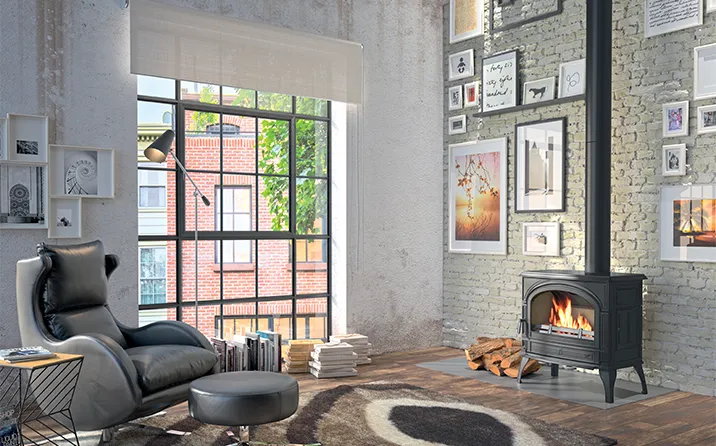
The insulation of your home is undoubtedly the most decisive factor when choosing the output of your wood-burning stove, sometimes even more so than the floor area itself.
Well-insulated homes: adjusting the output downwards
In a very well thermally insulated home (RT2012, RE2020 or high-performance energy renovation), heating requirements are significantly reduced. For this type of property:
- Reduce the calculated theoretical output by 30 to 40%
- Opt for appliances with a wide adjustable output range
A passive or very high energy performance home may require only 0.4 to 0.6 kW per 10 m²—almost half that of a standard property. In this context, choosing a stove that is too powerful could lead to overheating and force you to constantly reduce the burn rate, thereby decreasing efficiency and increasing emissions.
Poorly insulated homes: compensating with higher output
Conversely, an older, poorly insulated home (built before 1980 without energy renovation) has significant heat loss that must be compensated for by higher heating output:
- Increase the calculated theoretical output by 20 to 50% depending on the level of thermal insulation. It is advisable to consult a SEGUIN advisor, who will be able to provide you with the most suitable solution.
- Take into account aggravating factors (large single-glazed windows, uninsulated loft space, etc.)
- Consider exposure to prevailing winds and the orientation of the property.
For very poorly insulated homes, it may be advisable to consider improving thermal insulation before installing a wood-burning stove. This will not only reduce the required output, but also significantly improve your comfort and reduce your wood consumption.
The risks of incorrect sizing
Choosing a wood-burning stove with an output that is not suited to your home can lead to various issues affecting your comfort, your budget and even the lifespan of your appliance.
Read our article: how to choose your wood-burning stove?
Consequences of an undersized wood-burning stove
A wood-burning stove with insufficient output for the actual needs of your home will struggle to reach and maintain a comfortable temperature, especially during periods of very cold weather:
- Inability to properly heat the entire space
- Discomfort and a persistent feeling of cold in certain areas of the home
- Need to rely on supplementary heating, increasing energy bills
Problèmes liés à un poêle à bois surdimensionné
À l’inverse, un poêle à bois trop puissant pour votre espace habitable présente d’autres inconvénients :
Surchauffe rapide de la pièce, créant un inconfort thermique
Obligation de réduire constamment l’allure, entraînant une combustion incomplète
Production accrue de polluants et encrassement plus rapide du conduit
Rendement énergétique diminué lorsque l’appareil fonctionne au ralenti
Gaspillage de combustible et donc surcoût financier
Un poêle surdimensionné vous obligera à fonctionner principalement à allure réduite, ce qui provoque une combustion incomplète des bûches, génère davantage de particules fines et diminue considérablement le rendement de l’appareil. Le modèle HWAM 3120C avec sa technologie de combustion avancée peut partiellement compenser ce problème grâce à sa large plage de puissance modulable.

How can you optimise the efficiency of your wood-burning stove?
Beyond output, efficiency is an essential criterion when choosing a wood-burning stove. A high-efficiency appliance will convert the energy of the wood into usable heat more effectively.
The importance of efficiency in overall performance
The efficiency of a wood-burning stove represents its ability to convert the energy contained in the fuel into effective heat for your home:
- A modern wood-burning stove generally has an efficiency of between 70% and 85%
- Models certified with the 7-star Flamme Verte label guarantee a minimum efficiency of 75%
- At the same output, an appliance with higher efficiency will consume fewer logs
For example, an 8 kW stove with an efficiency of 85% will deliver more useful heat than a model of the same output with 70% efficiency, while consuming less fuel. Stoves from the MIRO range stand out for their excellent efficiency, ensuring optimal performance.
Practical tips to improve efficiency
To get the most out of your wood-burning stove and optimise its efficiency on a daily basis:
- Use dry wood (moisture content below 20%) for optimal combustion
- Use top-down lighting, which reduces pollutant emissions
- Maintain sufficient air supply to ensure complete combustion
- Clean your appliance regularly and have the flue swept twice a year
- Adjust the log load to your actual heating needs
- Promote the circulation of warm air in your home with a ceiling fan set to winter mode
These simple practices will help you optimise the performance of your wood-burning stove, whatever its output, and significantly reduce your fuel consumption.
FAQ: Your questions about wood-burning stove output
What output for a wood-burning stove for 100 m²?
For a 100 m² home with standard insulation, a wood-burning stove with an output of 8 to 10 kW is generally recommended. Adjust downwards (5–6 kW) for high-performance insulation or upwards (11–12 kW) for poor insulation.
Is it better to choose a stove that is slightly more powerful than necessary?
No, it is preferable to choose a stove with an output that precisely matches your needs. A slightly undersized model operating at full capacity will be more efficient than an oversized model running at a low setting. For greater flexibility, opt for an appliance with a wide adjustable output range.
How can I tell if my current stove has the right output?
Observe how it operates: if it easily reaches the desired temperature without overheating the room, its output is probably suitable. If it constantly runs at full capacity without providing sufficient heat, it is undersized. Conversely, if it quickly overheats and forces you to turn it down, it is oversized.
What is the difference between nominal output and maximum output?
Nominal output corresponds to the appliance’s optimal performance under normal operating conditions. Maximum output is the highest level the appliance can reach over a short period of time. For your calculations, always base them on the nominal output.
Can a wood-burning stove heat an entire floor?
Yes, a properly sized and well-positioned wood-burning stove can heat an entire floor, provided the layout allows for good circulation of warm air. Openings (doors, staircases) should remain accessible to facilitate heat distribution. For larger spaces or more compartmentalised homes, a warm air distribution system may be required.
How does ceiling height influence the choice of output?
A ceiling height above average (2.5 m) increases the volume to be heated. For each additional metre, increase the calculated output by 15 to 20%. For example, for a 50 m² room with a height of 3.5 m, the required output will be around 30% higher than that needed for the same floor area with a standard ceiling height.
Choosing the ideal output for your wood-burning stove is an important decision that will impact your thermal comfort and energy budget for many years to come. Do not hesitate to consult a Seguin professional for personalised advice and to find the model perfectly suited to your home and your specific needs. Visit our showroom to discover our full range of wood-burning stoves with different output levels.