




Following a significant rise in 2022, the price of wood pellets has increased substantially, doubling or even tripling. A large number of consumers have been affected by this wood pellet crisis.
This significant increase has led to a shift in preference among many consumers, who have turned to wood-fired heating. What is the current price of pellets? Are pellets still a competitive heating solution?
Pellet heating: a cost-effective heating system
For many years, wood pellet heating has established itself as a popular and environmentally friendly alternative to traditional heating systems. Indeed, wood pellets, made from compressed wood waste such as wood shavings and sawdust, provide an efficient and sustainable source of heat.
Nevertheless, in 2022, the price of wood pellets rose significantly, prompting consumers to switch to wood-fired heating. However, since January 2023, the price of pellets has fallen sharply and has stabilised since April 2023.
Indeed, according to a press release from the Propellet association regarding pellet prices, the association has “noted a significant drop in the price per tonne of pellets, and consequently per bag, at many retailers across the country.”

The price of pellets in 2023
As mentioned earlier, since January 2023, the price of wood pellets has fallen steadily before stabilising in April 2023. Indeed, for several weeks now, the price of wood pellets has remained unchanged, making them once again one of the most stable and affordable sources of renewable energy on the market.
At the same time, wood pellets play a crucial role in decarbonisation and energy independence, making them an essential heating solution in the energy transition.
Furthermore, the end of the price cap on electricity in 2024 – as Gabriel Attal pointed out on 13 July on RTL – and on gas in July 2023 will exacerbate the situation. From August 2023, the price of electricity will rise by 10%, increasing bills by around €150 a year.
To illustrate our point, here is a price index showing the trend in energy costs in euro cents (including VAT) per kWh (net calorific value) for use as the primary heating source:
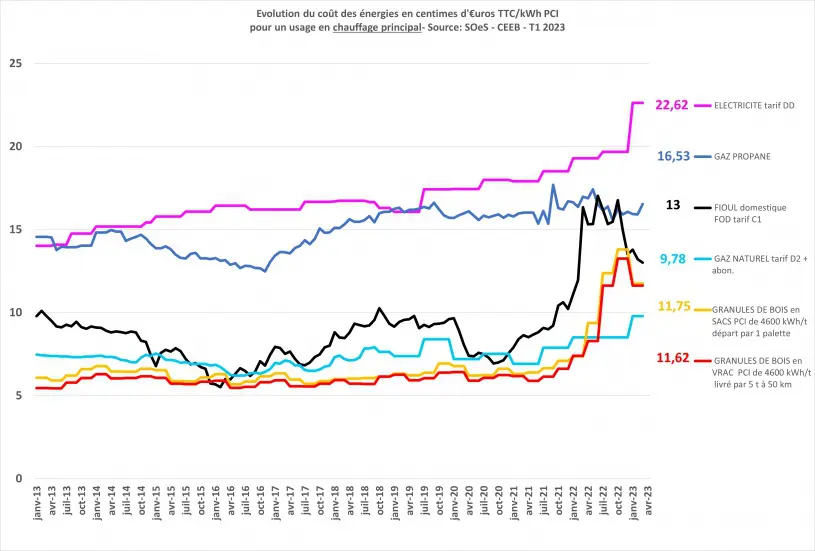
This price index, published by Propellet, the national association of wood pellet heating professionals, is based on a quarterly survey conducted by the Centre for the Study of the Timber Economy (CEEB) amongst a large number of stakeholders in partnership with Propellet. As regards other energy sources, Propellet uses data provided by the SOeS (Observation and Statistics Service of the Ministry of Sustainable Development) via the Pégase database.
As can be seen, the price of pellets has fallen significantly since January 2023 and has been stabilising since April 2023.
The same trend can also be seen among pellet suppliers. At present, the price stands at around €6.50 for a 15-kg bag and €501 for a pallet of 66 bags, which works out at €0.51 per kg.
Should you heat your home with wood pellets, electricity or gas?
To provide further clarity on the most cost-effective heating solution on the market, Propellet has carried out a comparison of the annual costs for a household living in a 90 m² home and a 150 m² home:
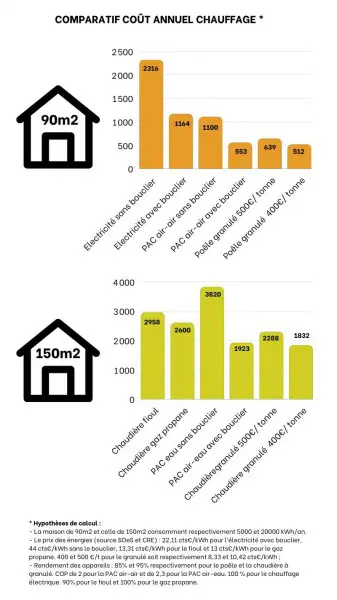
As the graph shows, heating with a wood pellet stove is currently just as cost-effective as heating with a heat pump, and this trend is set to become even more pronounced in the coming months with the removal of the price cap.
So, if you’re still hesitating to take the plunge, now is the right time to invest in this heating system, which is efficient, sustainable and cost-effective.